
Trending
Building Design for Animals
Finding the Right Footing: Flooring Materials for Veterinary Hospitals
A new question has hit the Q & Arooo inbox, and BDA’s Barkitect has answers and information about flooring options and best choices in veterinary practices.
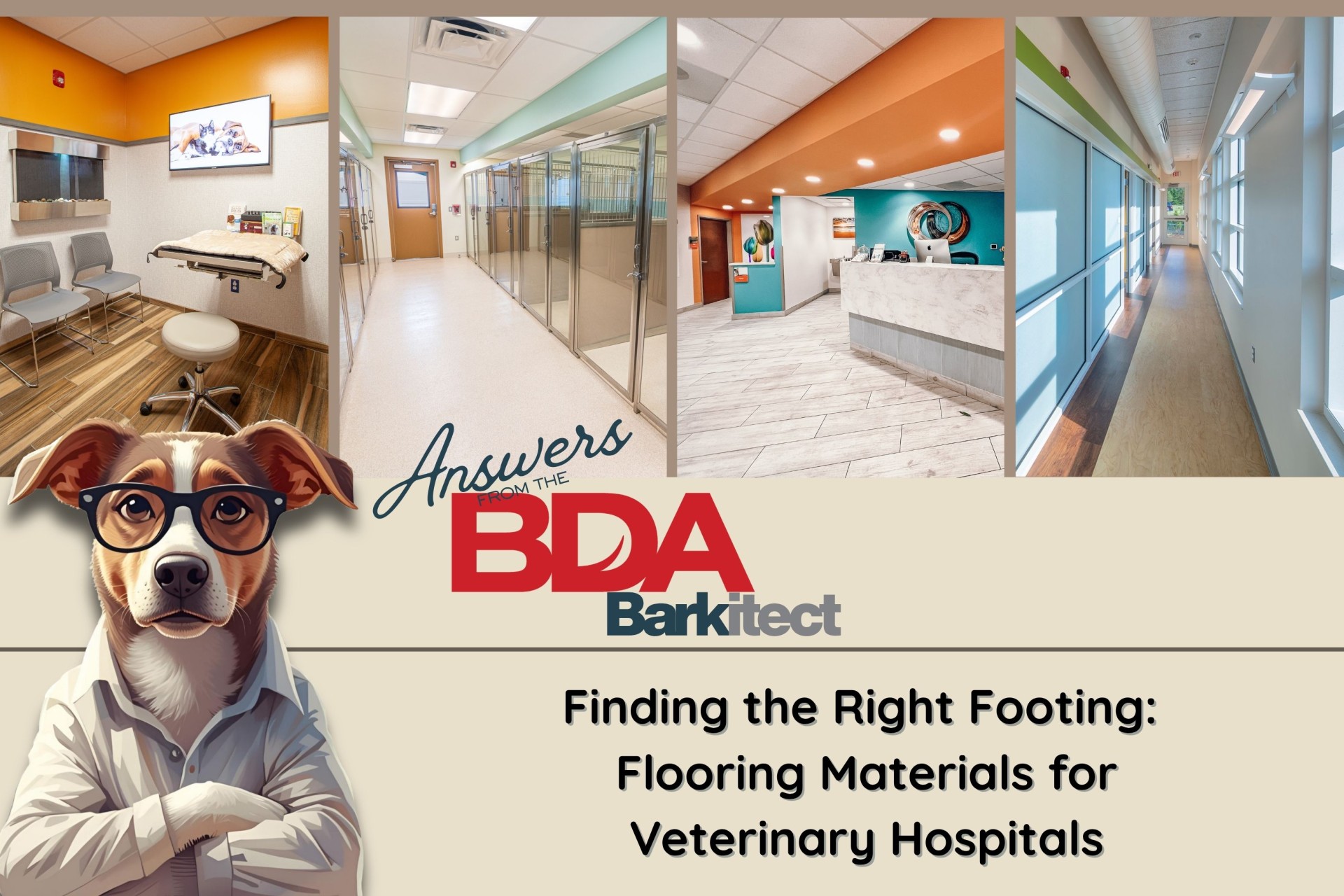
Question: "What flooring materials hold up best in veterinary environments with animals, cleaning chemicals, water, and heavy equipment?"
Selecting the right flooring for a veterinary facility isn't a simple, one-size-fits-all decision. Between constant paw traffic, harsh chemical sanitizers, standing water, rolling equipment, and staff standing for long hours, different zones in your hospital demand vastly different flooring properties.
To build a durable, hygienic, and safe hospital, key flooring materials are best broken down by performance and where they work most effectively:
Resinous Flooring & Methacrylate Resin (MMA)
Resinous flooring is a poured, layered, seamless system that eliminates dirt-trapping seams or grout lines. Methacrylate Resin (MMA) options offer extreme durability against heavy traffic, harsh chemicals, and heavy impacts, with a lifespan lasting up to 20 years, and a quick curing time compared to other materials.
While resinous systems can be hard to beat when it comes to durability, chemical resistance and seamless hygiene, there are some drawbacks. This flooring type can be hard to stand on for both people and animals. It also presents a higher initial material and labor investment. When not installed correctly, bubbling or peeling can result.
Achieving the ideal balance between slip-resistance for patients and cleanability for staff requires exact aggregate sizing during application. BDA works with practice owners to define precise texture specs, sloped drain profiles, and integrated flash-coving tailored to their daily washdown protocols.
Best Used In: Animal housing, kennels, utility spaces, and wet areas.
Porcelain Tile
Made from fine clay fired at high temperatures, porcelain is non-porous throughout and extremely dense. It handles heavy equipment and foot traffic while offering an elevated, high-end look for client-facing zones.
One concern with porcelain tile isn’t the tile itself–it's the medium holding it in place. Standard tile grout is porous and will absorb liquids, harbor odor, and break down under aggressive cleaning chemicals over time. As for the tiles, the hard surface offers zero acoustic dampening or underfoot fatigue relief.
Tile failure in clinics almost always comes down to grout selection and subfloor deflection. BDA can specify high-performance systems and ensure correct substrate engineering to mitigate these concerns. Selecting the right surface texture is also crucial to ensure paws don't slip on wet tiles.
Best Used In: Client-centric areas (lobbies, reception, exam rooms), animal housing, and grooming/high-water areas.
Sheet Vinyl & Sheet Rubber
For areas where comfort, noise reduction, and seamless protection need to coexist, sheet resilient flooring excels. Unlike tile or LVT, sheet goods come in large rolls (typically 6' wide) and can be chemically welded at the seams to create a continuous, monolithic surface. They offer antimicrobial properties, exceptional durability under active conditions, and added cushioning that reduces fatigue for staff standing for long periods.
Where it falls short is its lower resistance to heavy rolling loads (like heavy equipment or large cages) compared to concrete or tile, which can lead to tearing or indentation if the wrong grade is specified. Color options can also be limited, and seams can collect dirt if not properly maintained.
Transitions are everything with sheet goods. BDA designs seamless wall-to-floor flash-coving details and specifies adhesive formulations that resist moisture from both above and below the subfloor.
Best Used In: Treatment areas, medical spaces, and animal exercise/play zones.
Luxury Vinyl Tile (LVT)
For front-of-house spaces where warm aesthetics are a priority, commercial-grade LVT offers a great balance of budget and appearance. This flooring features a thick wear layer and enhanced urethane finishes that stand up well to heavy foot traffic. It also provides infinite style choices (wood, stone, and geometric patterns) at a lower material cost.
Because LVT contains un-welded butt joints/seams, it is not recommended for wet treatment rooms or animal housing where liquids and chemicals are heavily used. If liquids, urine, or harsh cleaning chemicals pool on the surface, moisture can seep through the seams, destroying the adhesive underneath and causing tiles to lift.
LVT is a fantastic budget tool when contained to the right zones. BDA helps practice owners map out strict boundaries between 'dry' front-of-house areas and 'wet' clinical spaces so LVT thrives without premature seam failure.
Best Used In: Lobbies, waiting rooms, corridors, and administrative offices.
Sealed & Stained Concrete
Sealed concrete is a slab treated with a clear topical or penetrating sealer, while stained concrete forms a permanent chemical bond that won't peel or chip under heavy equipment. For utility and back-of-house storage, concrete remains an extremely rugged, cost-effective, and tough substrate.
However, cracks can be a major drawback. Over time, concrete can develop hairline fractures, and topical sealers will require touch-ups or resealing. It is also inherently cold, hard, and unforgiving on staff joints.
Concrete requires careful moisture evaluation and joint planning to ensure topical sealers bond long-term rather than flaking away under heavy washdown.
Best Used In: Mechanical rooms, storage, laundry, and bulk supply spaces.
The True "Secret" to Hospital Flooring: Implementation
Every veterinary practice operates differently—your workflow, cleaning products, patient mix, and building slab conditions all dictate what will work long-term. Rather than choosing a single material for your entire hospital, mixing and matching materials based on room function ensure longevity, safety, and a cleaner environment for both patients and staff.
BDA Trending is our monthly newsletter featuring articles and insights on the latest in veterinary design. Through our "Q & Arooo" segment, we invite readers to submit questions or request specific topics for our team to cover.
Join the pack: Subscribe to the newsletter and Submit your "Q & Arooo" question to stay ahead of the latest trends in animal care architecture.